


A video about Carl Jung and synchronicity recently found its way to me.
I could say that I found it through the ordinary machinery of the internet. An algorithm placed it in front of me. I clicked. I listened. I recognized ideas I had encountered before.
That would all be true.
But it would not fully describe the experience.
The video arrived while I was deeply immersed in the language of symbols, cycles, mind maps, memory, and meaning. It articulated something that has quietly existed within Quantum MeMoir from the beginning:
Life does not always speak to us in complete sentences.
Sometimes it speaks through repetition.
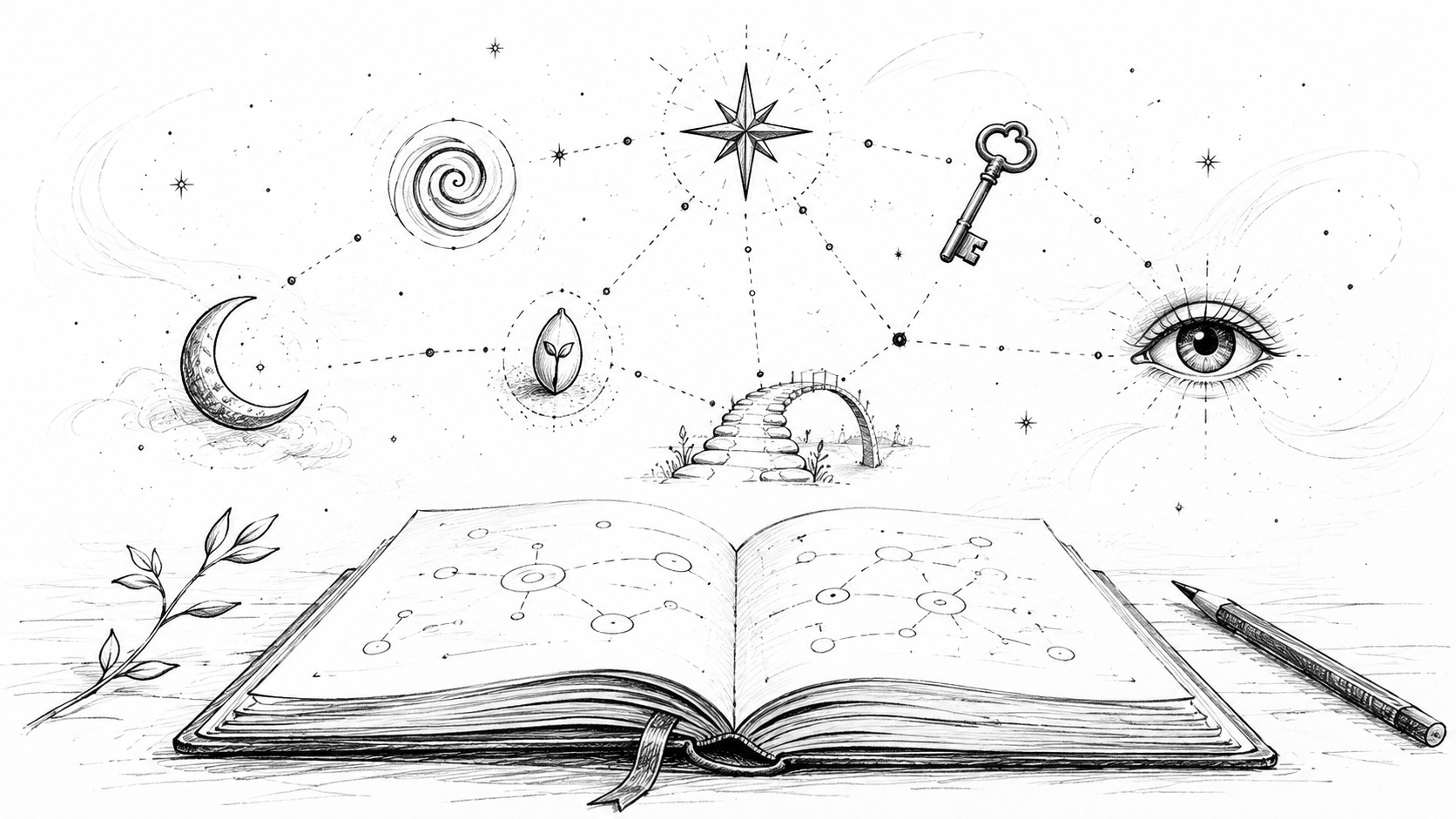
A symbol appears in a dream and then on the cover of a book. A conversation echoes a question we have been privately carrying. A person arrives at the exact moment we have become ready to hear what they have to say. An old memory resurfaces alongside a new possibility, connecting two periods of life that once seemed unrelated.
The events themselves may be ordinary.
The meaning created between them is not.
This is the territory Jung called synchronicity, a meaningful coincidence in which two events may have no obvious causal relationship, yet become connected within the lived experience of the person observing them.
Quantum MeMoir approaches this territory with both curiosity and discernment.
It does not require us to believe that every song on the radio is a command from the universe. It also does not require us to dismiss every meaningful encounter as random noise.
Instead, it invites us to pause long enough to notice when life begins to rhyme.
Meaning Is Not Located in the Event Alone
A coincidence becomes synchronistic not because it is statistically improbable, but because it touches something that is already active within us.
Imagine two people seeing the same image of an open door.
One person walks past without giving it another thought.
The other person has been contemplating whether to leave a job, begin a creative project, return to school, or step into an unfamiliar chapter of life. For that person, the door seems to glow with invitation.
The image has not objectively changed.
The relationship between the image and the observer has.
This distinction is central to Quantum MeMoir theory. We do not experience life as neutral collectors of facts. We participate in the creation of meaning through what we notice, remember, associate, question, and connect.
We are always gathering fragments:
A feeling
A word
A drawing
A dream
A conversation
A recurring problem
A phrase someone said years ago
A symbol we cannot stop thinking about
At first, these fragments may resemble stars scattered across a night sky. Each one appears distant from the others. Yet when we begin connecting them, a constellation emerges.
The constellation does not erase the individual stars. It reveals a relationship between them. A Quantum MeMoir is created in much the same way.
It is not merely a record of what happened. It is the gradual recognition of how separate experiences belong to a larger pattern of becoming.
Why Synchronicity Appears at Turning Points
According to the video, Meaningful Coincidences seem to become more visible during periods of transition.
A familiar identity is weakening.
A relationship is changing.
A career no longer contains the same energy.
A home is being left behind.
A new role is forming, but has not yet become stable.
The old chapter has ended internally, even if its external structures are still standing. The new chapter can be sensed, but not yet clearly described.
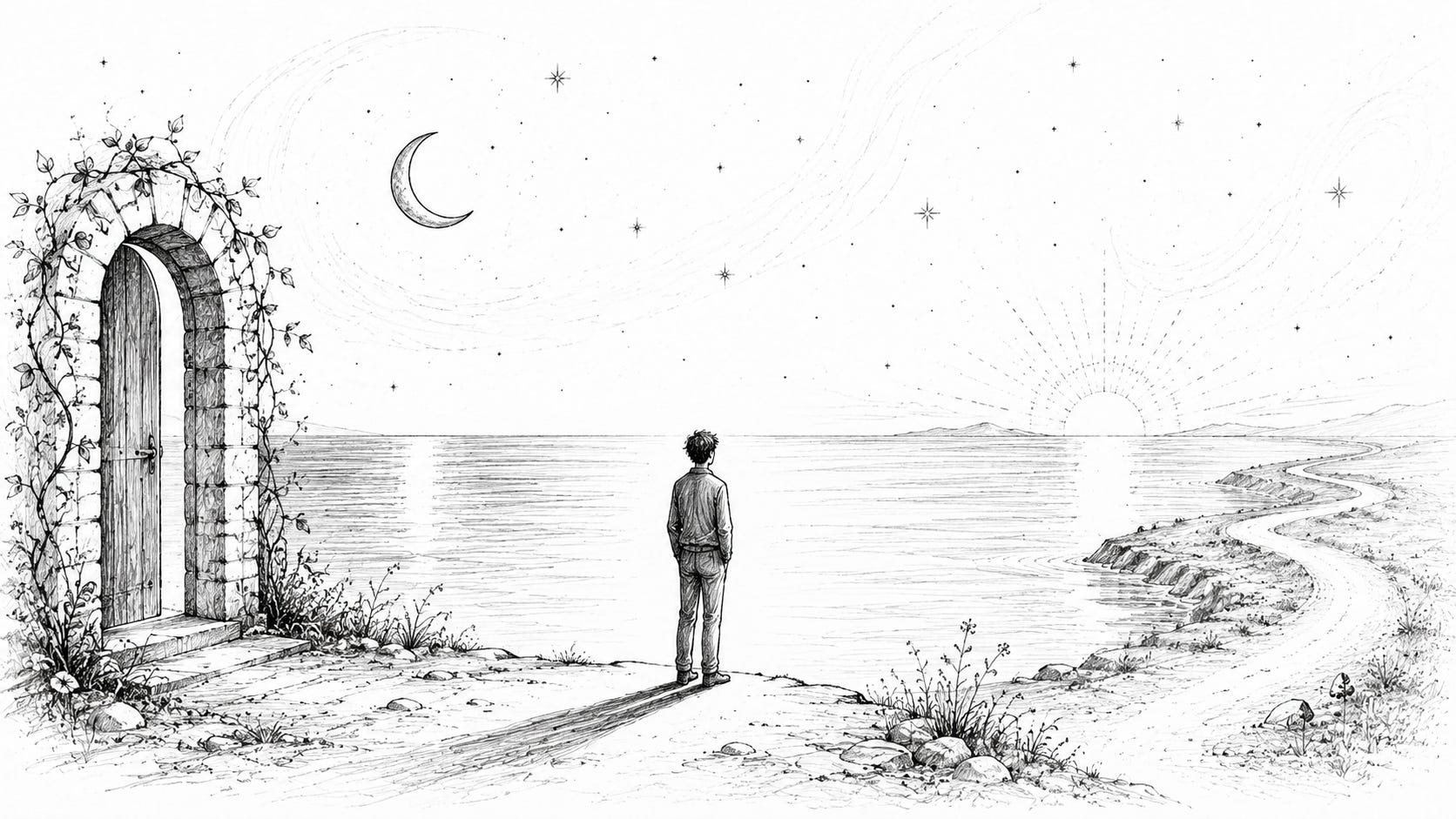
The video suggested Carl Jung used the image of a “Night Sea Journey” to describe this psychological condition. The old shore has disappeared behind us, but the new shore has not yet become visible.
Quantum MeMoir recognizes this as an interval.
An interval is not empty time. It is a sphere of reorientation. It is liminal.
During stable periods, much of our attention is directed toward maintaining what already exists. We follow routines, fulfill roles, meet expectations, and repeat familiar interpretations.
During transitions, those structures loosen. Questions begin entering through the openings. And questions always attract answers…
Who am I without this role?
What is trying to end?
What is asking to begin?
What do I know now that I could not have known before?
What wants to move through me next?
When the established narrative no longer holds, we become more receptive to information that might help us form a new one. Books, symbols, encounters, memories, and dreams appear to gather around the questions occupying our attention.
This does not necessarily mean that more unusual events are occurring.
It may mean we have become more available to notice them.
Our lives are continually presenting information. A turning point in life changes the frequency to which we are listening.
The Unconscious Speaks in Images
Evidently, the conscious mind prefers orderly explanations.
It wants conclusions, categories, instructions, and evidence. It wants to know what something means and what should be done about it.
The unconscious often communicates differently.
It speaks through images, sensations, dreams, metaphors, emotional reactions, stories, and recurring symbols. It may present an eye, a key, a tree, a spiral, a seed, a bridge, a dragon, a house, or an open door long before we understand why that image matters.
This is one reason art is inseparable from the Quantum MeMoir method.
A doodle is not merely decoration. A symbol can hold information that has not yet become language.
When we draw before we explain, we give an emerging idea somewhere to exist before it has been fully interpreted. The imagination may recognize a pattern before the rational mind knows how to describe it.
This is the deeper purpose behind Draw & Tell.
First, draw what appears.
Then, allow it to tell.
The telling may happen through words, associations, memories, questions, or another image. It may happen immediately, but often it unfolds gradually.
The meaning was not necessarily hidden in the symbol as a universal answer.
It developed through our relationship with it.
A symbol may enter one mind map and return several months later in another. A shape drawn during a period of confusion may acquire new meaning after a decision has been made. A seed may later reveal itself as the beginning of a cycle. A door may come to represent the threshold we were afraid to cross.
Observe Is an Active Practice
The video suggested, some people seem to experience synchronicity everywhere. Others rarely notice it at all.
This does not necessarily mean that one life contains more meaning than another. It may reflect a difference in attention.
The Observe Sphere of the Quantum MeMoir Base Code asks us to study Self, Other, Experience, Nature and Society. Observation is not passive looking. It is the intentional practice of noticing what is present, what repeats, what changes, and what creates a response within us.
Attention determines which information enters the story.
When we are focused only on function, we may see a book, a stranger, a dream, and a conversation as four unrelated events.
When we become attentive to pattern, we may notice that all four contain a relationship.
The Quantum MeMoir practice is not to immediately declare that the pattern is a message sent from the Universal Field. It is to become curious about why this particular pattern has become visible now.
What am I currently contemplating?
What emotion accompanies this symbol?
What part of my life does it seem to touch?
Has it appeared during another important cycle?
Observation gives synchronicity somewhere to land. Without observation, the moment passes. Without reflection, it remains an isolated event. Without discernment, it can become superstition.
The Quantum MeMoir practice incorporates all three.

The Base Code of a Meaningful Coincidence
A synchronistic experience can move through the entire Base Code.
Purpose identifies the central question or theme currently alive within us.
Ground notices the bodily and emotional response. Did the experience create calm, recognition, discomfort, excitement, or unease?
Intend asks where our attention was directed before the event occurred.
Observe records what happened without immediately turning it into a conclusion.
Connect looks for relationships among memories, people, symbols, dreams, and present circumstances.
Express gives the experience a form through writing, conversation, drawing, or storytelling.
Refine separates genuine insight from projection, wishful thinking, fear, and premature interpretation.
This final sphere is essential. Not every coincidence requires action. Not every repeated image is an instruction. Not every strong feeling is evidence that our interpretation is correct.
Refinement allows us to remain open without becoming ungrounded. We can honor the experience while continuing to question the meaning we assign to it.
This is how synchronicity can support sovereignty. A meaningful coincidence should not make our decisions for us. It can help illuminate what is already asking for our attention.
From Personal Symbols to Universal Patterns
Jung believed that beneath our personal memories lies a deeper layer of shared human patterning, which he called the Collective Unconscious.
