
Today is the Intend Sphere, which seemed fitting because Molly had been thinking about blueprints from something Stewart Wilde mentioned in a video the other day...
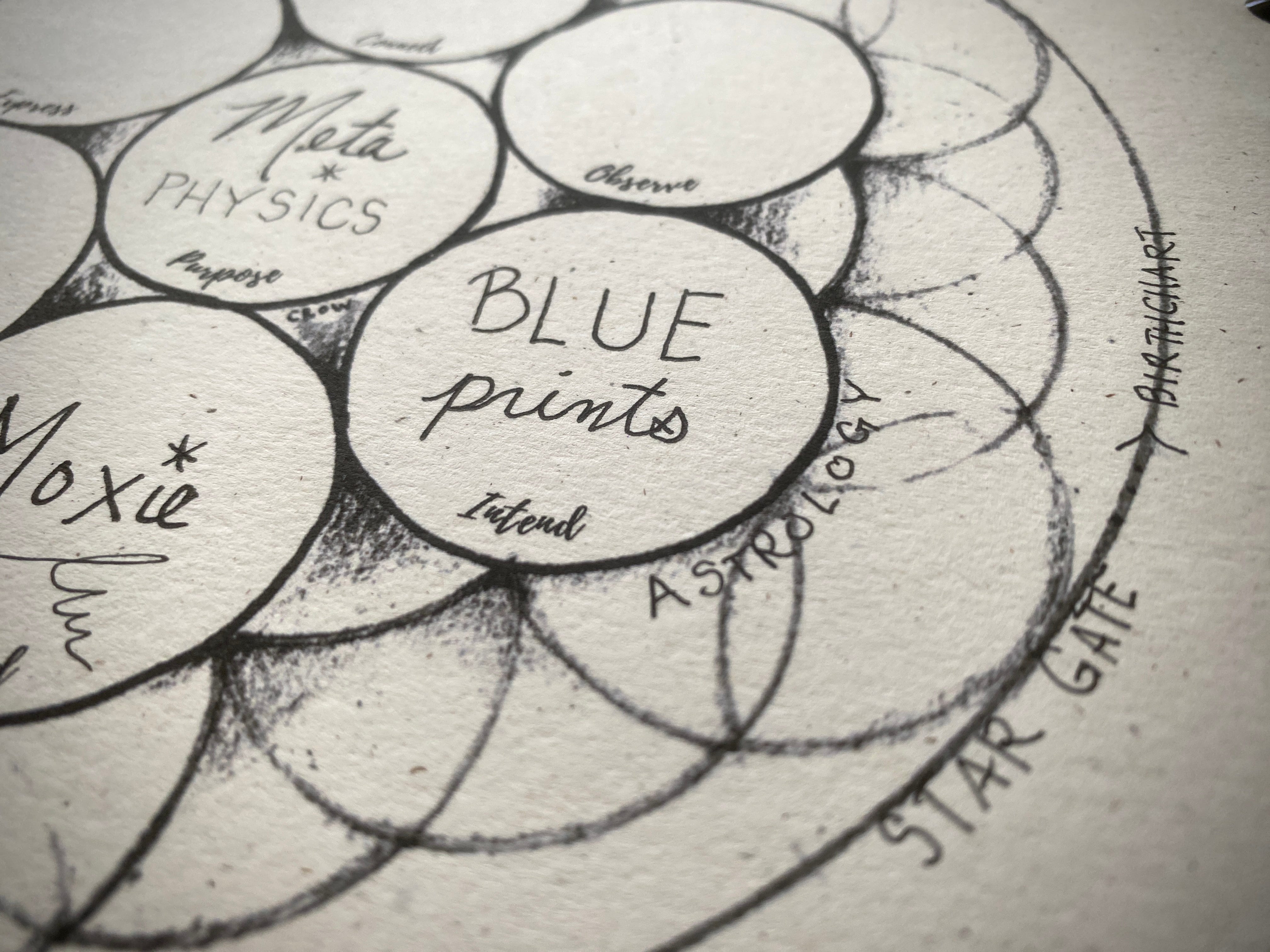
She wrote the word BLUEprints across the page, giving the word a little more room to breathe. The blueprints were the birth chart, at least in the language she was developing for herself. A map of the sky at the moment a person entered the world. A pattern. A set of symbols. An archetypal starting point.
But a blueprint isn’t a building.
That distinction had become important.
She kept returning to Carl Jung’s idea that when the unconscious remains unconscious, it directs a person’s life and eventually gets called fate. Molly had been turning that idea around in her mind, looking at it from several directions.
Maybe the birth chart was a blueprint.
But perhaps the mind was the architect.
The blueprint could suggest a structure, but it didn’t necessarily dictate what would be built. An architect could study the plans, understand the materials, discover the limitations, notice the possibilities, and then make choices.
Maybe that was what intention was, not pretending there was no blueprint.
Learning how to read it.
Molly had drawn her Star Gate Mind Map, her visual interpretation of the zodiac chart. It wasn’t simply an astrology chart to her anymore. It was becoming a kind of thought-form machine, a way to make archetypes visible enough to study.
The longer project was beginning to take shape around it: a Star Gate Mind Map Exercise and an Astrology Draw & Tell Deck.
But before she could build the deck, she realized she needed to find the blueprints for the blueprints.
Her old studies.
The annotations in the margins.
The strange little symbols.
The notebooks.
The previous mind maps.
The questions she had written years ago and forgotten she had asked.
The ideas that had appeared before she had language for them.
All of that material was still there. It was evidence of how her own mind had been constructing meaning over time. So perhaps the first step wasn’t creating something new at all.
It was archaeology.
Molly needed to gather the pieces of her own thinking and lay them out where she could see them. Her past studies could become a map of the mind that had been studying the map.
That recursive quality amused her. The birth chart could be a blueprint. Her studies could become another blueprint. The mind map could map the birth chart. The Draw & Tell Flash Card deck could teach someone how to make a mind map of their own archetypal blueprint. And then the person studying the map would inevitably become part of the map.
There was something wonderfully circular about it.
She thought about her family, too. Her daughter and husband both had solar returns during this lunation, under Virgo, while her own solar return was approaching on the horizon.
It gave the project a living laboratory, a place where symbols could be observed through actual human lives.
What happens when an archetypal pattern becomes visible?
Does knowing the pattern change the way someone inhabits it?
Does naming something loosen its grip? or tighten it?
Does an unconscious tendency become more flexible once it has a relationship with the whole? And this brought Molly back to something else she had been noticing lately.
The mind contains so many things that feel like (little s) “self” simply because they are inside the mind.
Preferences.
Judgments.
Opinions.
Little declarations that arrive already formed:
I don’t like that.
That’s embarrassing.
That’s what people like us do.
That’s beautiful.
That’s stupid.
But where did those voices come from?
Some were inherited. Some were learned. Some were protective. Some came from people who had mattered. Some came from culture. Some were assembled quietly through years of watching what was rewarded, rejected, admired, mocked, loved, feared.
And perhaps some really were hers.
That was the interesting part.
She didn’t need to reject every thought. She could study it. She could look at a preference and ask where it came from. She could look at a judgment and ask who taught it to her. She could look at an opinion and wonder whether she had chosen it or merely remembered it.
Even the positive things could be examined.
I am good at this.
I am this kind of person.
I should want this.
Maybe those belonged to her. Maybe they didn’t…
The point wasn’t to empty herself of every influence until nothing remained. The point was to become conscious enough to choose. Perhaps this was what Molly meant by the architect.
The architect studies the Blueprints. Then picks up the pencil…
Today, the intention isn’t to determine what her life was supposed to become. It is to become more conscious of the patterns already present and see what she wanted to build with them.
And somewhere inside all of these ideas is the person holding the pencil.
Molly looked at the page again.
INTEND.
Not fate.
Not prediction.
Not permission.
A direction.
The blueprint was already on the table.
Now she wanted to see what she could build.
And perhaps this is where all those earlier studies of time and astrology begin to connect. The Solar, Lunar, and Earth Cycle work she has been building has been laying another kind of foundation: ways of seeing time not as a straight line disappearing behind her, but as a pattern she can enter, observe, reflect upon, and return to with new eyes. Those older mind maps and annotations are becoming part of the research archive for what comes next, the groundwork for the future Draw & Tell Star Gate Flash Card Set. The deck isn’t finished yet…
For now, Molly is gathering the pieces, studying the patterns, and letting the next version reveal itself. And if the idea of exploring your own cycles sparks something in you, the Universal Time Cycle Mind Maps are a gentle place to begin your own (r)Evolution of Time, with Solar, Lunar, and Earth cycles to help turn intention into something you can actually see.
Further Exploration:
These posts and videos directly relate to the Universal Time Cycles and Astrology Calendar and Mind Map.
The Power of Time
Time shapes how we organize society, plan our days, and even celebrate our beliefs. Yet the deeper we look into the origins of calendars—especially those still in use today—the clearer it becomes that timekeeping has often served not just as a neutral convenience but as a tool of control.


