


For years, I have thought of the Quantum MeMoir Mind Map as more than a tool for organizing thoughts.
I have seen it as a form of scientific note-taking.
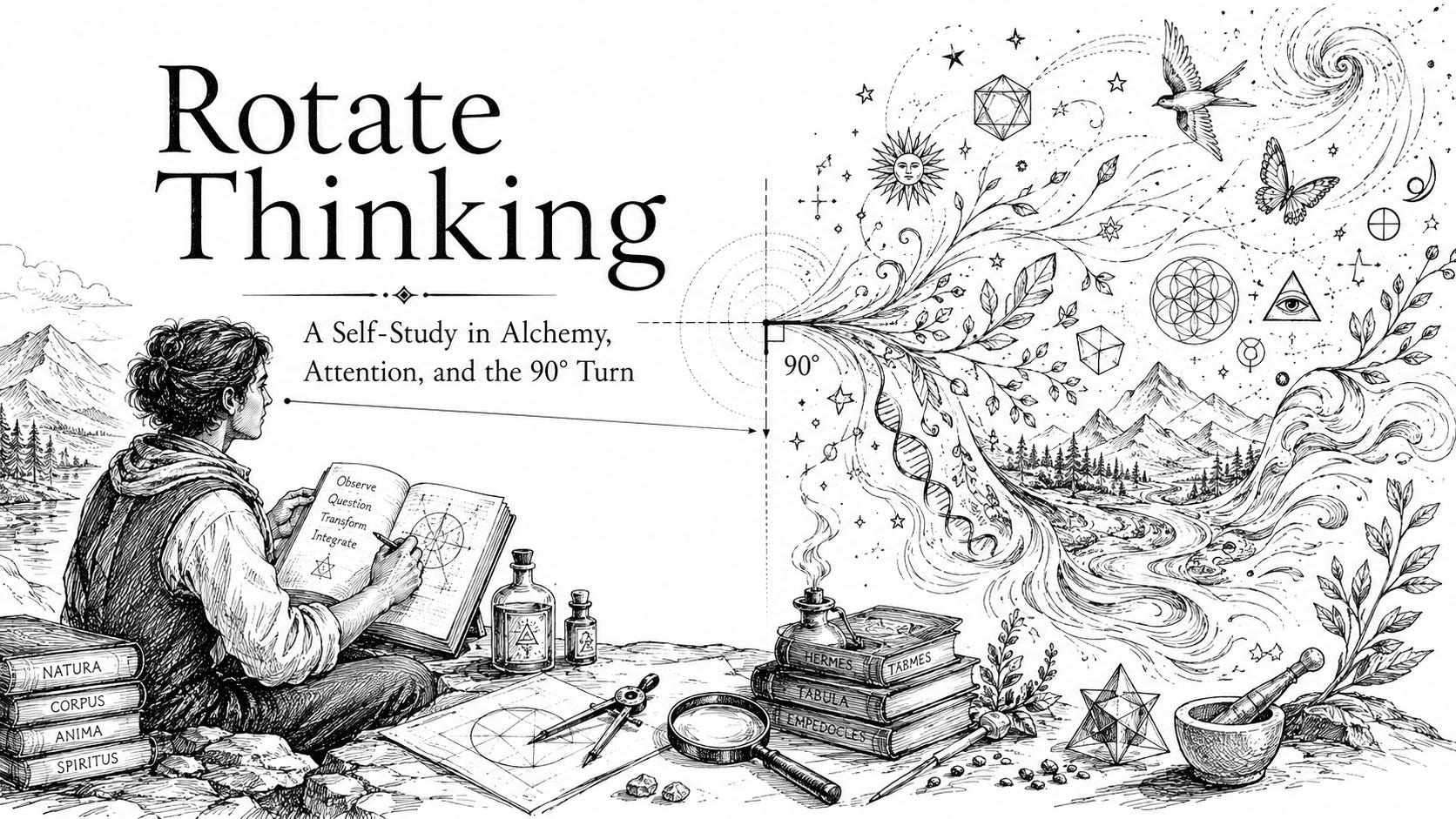
Not science in the institutional sense of laboratories, instruments, and published conclusions, but science in its oldest and simplest sense: observation, inquiry, experimentation, pattern recognition, and the willingness to revise what we think we know.
The Quantum MeMoir Mind Map gives an experience a center, then asks us to move around it. To look again. To change perspective. To notice what becomes visible from another angle.
Recently, while revisiting the work of Stuart Wilde*, I began wondering whether this way of mapping experience might point toward a much larger hypothesis about consciousness itself.
What if the visible world is only one expression of a larger Recursive Field of information?
And what if consciousness is capable, under certain conditions, of perceiving more of that field than our ordinary waking awareness normally allows? I am not presenting this as established science. I am treating it as a thought experiment worth exploring.
Instead of immediately deciding that unusual experiences are either supernatural truth or meaningless fantasy, I am interested in a third position:
Enter the inquiry. Observe carefully. Map what happens. Test what can be tested.
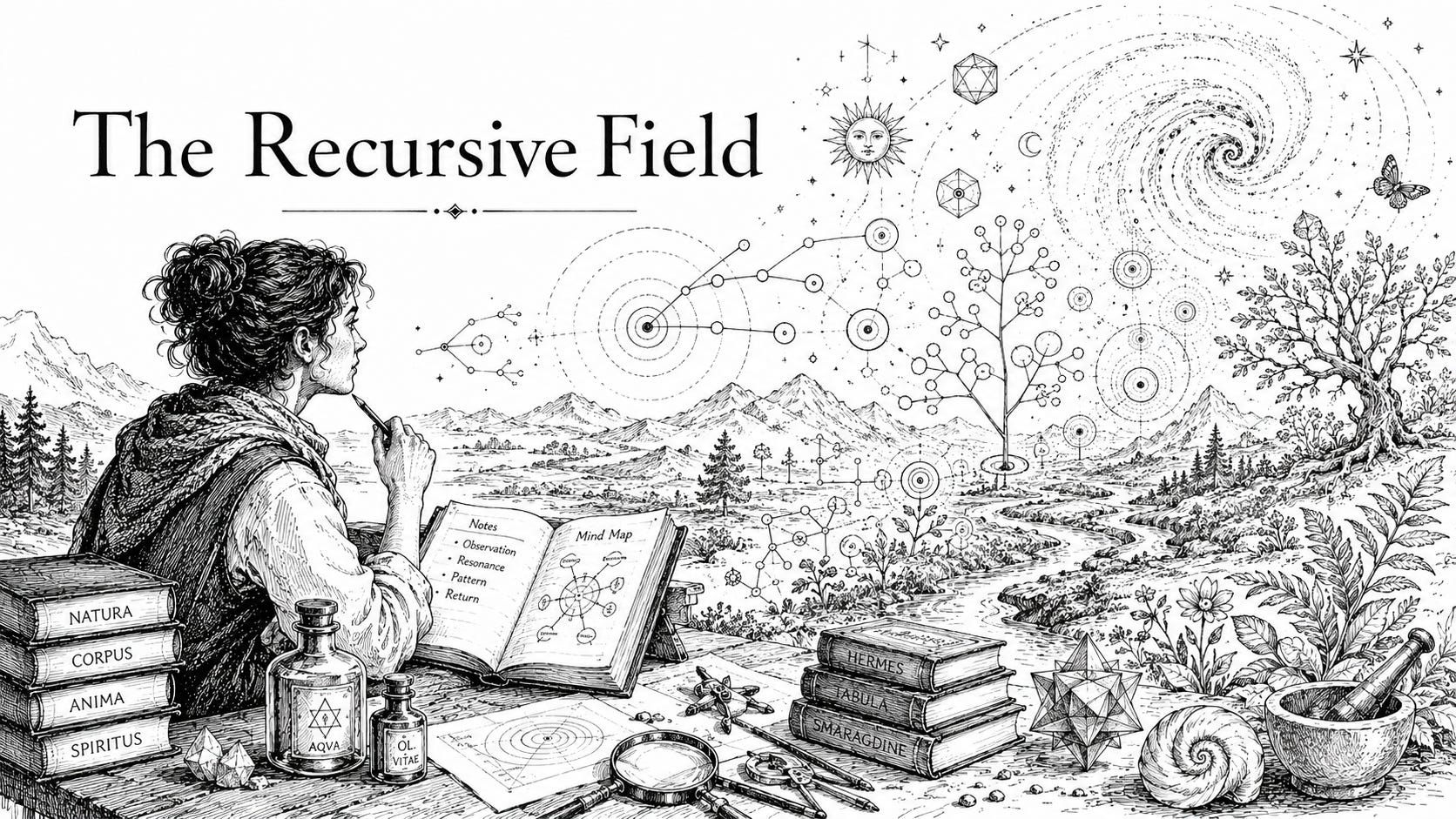
The Recursive Field
The first term I am using for this model is the Recursive Field. Recursive, meaning patterns repeating within larger patterns.
The Recursive Field is the underlying informational environment as a whole.
I use the word recursive because the same kinds of patterns seem to appear again and again at different scales: within a moment, within a life, within relationships, within nature, within cycles of time, and within the geometry of the Quantum MeMoir Thought Forms themselves.
A pattern can contain smaller versions of itself while also belonging to something larger.
In this exploration, our ordinary physical experience would not necessarily be separate from some invisible realm. It would be one expression of a larger whole.
The visible world of humans may be what the Recursive Field looks like when filtered through the biological senses, nervous system, memory, language, culture, and the particular position of an embodied observer.
This raises a much more provocative possibility:
Consciousness may not originate entirely inside the biological organism.
Embodiment may instead focus, limit, or tune us into a larger field of awareness.
The brain, from this perspective, would not necessarily create the totality of consciousness any more than a radio creates the broadcast it receives.
That analogy is only a hypothesis. But it creates a useful question:
What changes when we adjust the receiver?
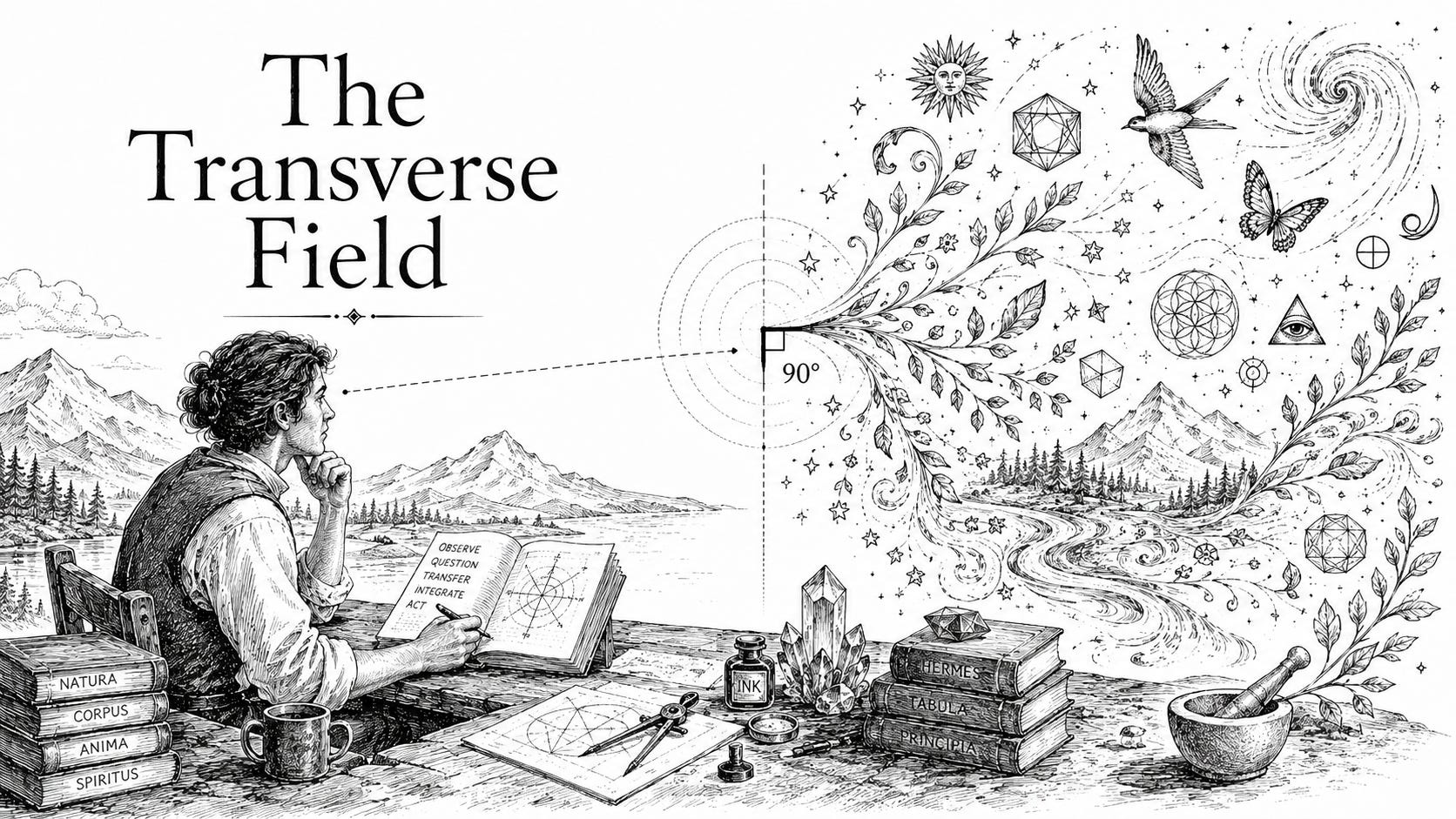
The Transverse Field
Within the larger Recursive Field, I am calling the normally less-visible aspect of experience the Transverse Field. The word comes partly from my exploration of Stuart Wilde’s idea of a reality existing at a 90-degree relationship to ordinary perception.
The physics is more nuanced than saying another dimension literally sits ninety degrees beside us.
Light itself offers an interesting analogy. Light travels forward, while aspects of the electromagnetic wave move in directions perpendicular to that path. Borrowing a concept from signal processing, I began thinking about experience as if it contained more than one channel of information. Signal science also uses the idea of two related components that are separated by 90 degrees of phase.
The scientific concepts do not prove the existence of another spiritual realm. But they offer an intriguing conceptual model.
A ninety-degree shift does not simply mean turning around and looking in the opposite direction. A 180-degree turn gives us the reverse of the same line.
A 90-degree relationship introduces another channel. Another aspect of the same signal. Another way of receiving information.
Neither idea proves another realm exists, but both give me a useful way to imagine information arriving through more than one channel.
That distinction became central to this inquiry.
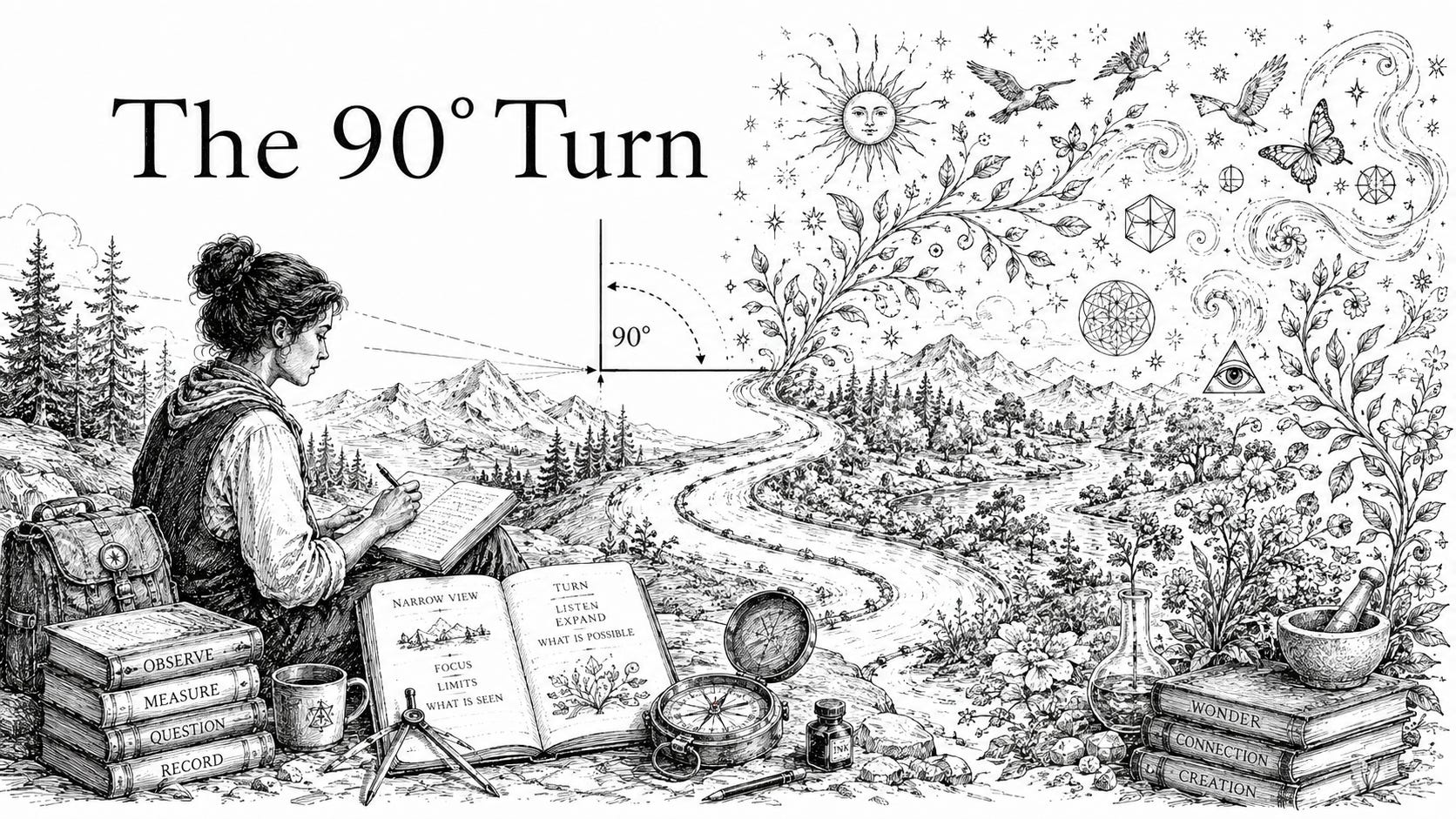
The 90° Turn
In Quantum MeMoir, I am beginning to think of the 90° Turn not as literally turning the body ninety degrees, but as changing the way we perceive.
It is a shift away from direct, narrow, physical attention toward a softer and more peripheral state of awareness.
Instead of asking only:
What am I looking at?
we might ask:
What is happening at the edge of my awareness?
Instead of immediately interpreting:
What does this mean?
we might first ask:
What appeared?
The turn might happen from analysis into sensation. From words into images. From focal vision into peripheral vision. From conscious thought into Active Imagination. From an object into the pattern surrounding the object. From the foreground into the background.
The 90° Turn is therefore a perceptual practice. It is a deliberate attempt to change channels.
