
Today, Molly observed humanity.
It happened quite literally… in a somewhat accidentally way.
She and her husband spontaneously decided to go antiquing. They got coffee and spent hours wandering through the aisles of objects humans had made, surrounded by remnants of an industrial world that once considered so many of these things new, useful, necessary, and valuable.
Now some were obsolete.
Some were nearly worthless.
Others had somehow become more valuable simply because they had survived.
There was something fascinating about standing among so many objects from another time. Things someone had designed, manufactured, purchased, used, loved, stored, forgotten, inherited, discarded, and eventually placed in an antique store.
Human beings do something peculiar with time. We assign value to things based on when they were made, how long they survived, how rare they became, who owned them, the story they carry, and whether someone still finds meaning in them.
Something can be valuable because it is new.
Something else can become valuable because it is old.
Age can make an object obsolete, or it can make it an artifact. And Molly wondered if perhaps human beings work that way, too.
She had been thinking a lot about safety and boundaries lately, particularly the vulnerability of having a body that changes with age. Somewhere inside that fear was an assumption that aging meant becoming less capable. Less strong. Less able to protect the boundaries of the body.
But today offered her another possibility.
Perhaps age does not automatically decrease value.
Perhaps some things become more valuable because they have endured. Perhaps the body is not an object whose worth diminishes as its newest features disappear. Perhaps it is an artifact of time itself.
A living record of every season it has survived.
The body is becoming older. But it is also becoming more experienced. More developed. More aware. More itself. And then Molly noticed something else.
She had spent hours out in the world surrounded by other human beings, and she hadn’t been afraid. She wasn’t scanning the room for danger. She wasn’t thinking about whether someone might cross her boundaries.
She felt good in her body.
She liked how she was carrying herself.
She liked the archetype she was embodying.
Powerful.
Bougie.
Self-possessed.
Whatever name she gave the character, something about inhabiting her made Molly feel valuable. And when she felt valuable, she experienced the humans around her differently.
That was important evidence.
Perhaps safety isn’t only about making sure nobody crosses the boundary. Perhaps safety also includes knowing the value of the being whose boundary exists. That realization reached backward through time.
Maybe this was something Molly understood instinctively when she was younger. Perhaps the woman she was in her twenties and thirties knew how to occupy her individuality without questioning whether she was allowed to have it.
Then came the great pendulum swing.
For nearly a decade, Molly had explored the shadows, perhaps in the way Carl Jung might have encouraged her to do. She went deep into the unconscious, the conditioning, the archetypes, the darker corners of human behavior and the parts of herself she couldn’t simply wish away.
She also experimented with the spiritual movement in the opposite direction.
Unity.
Oneness.
Expansion.
Chasing rainbows and sunshine.
We are one.
There was something valuable in both explorations. But perhaps the pendulum traveled far enough in both directions that Molly eventually found herself somewhere in the middle.
An interesting shade of gray.
As a Scorpio, she has never really been able to convince herself that the shadow will ever go away. She knows it is part of “Time on Earth.” So… perhaps she doesn’t need to choose between darkness and light.
She seems to do rather well with the haze in between.
But that realization belongs to another chapter.
For now, Molly was observing the word human.
She began looking into its etymology, as she often does when a familiar word starts feeling unfamiliar.
Human comes from Latin humanus, meaning human or of mankind, and ultimately belongs to an ancient linguistic neighborhood associated with the idea of an earthly being.
An Earthling.
That word caught her attention. Because the purpose of this particular cycle is Time on Earth.
Not time as an abstract number on a clock or calendar. Time as an experience of being here. On this planet. Inside this body. Moving through lunar cycles, seasonal cycles, solar cycles, biological cycles, and the finite cycle of a lifetime.
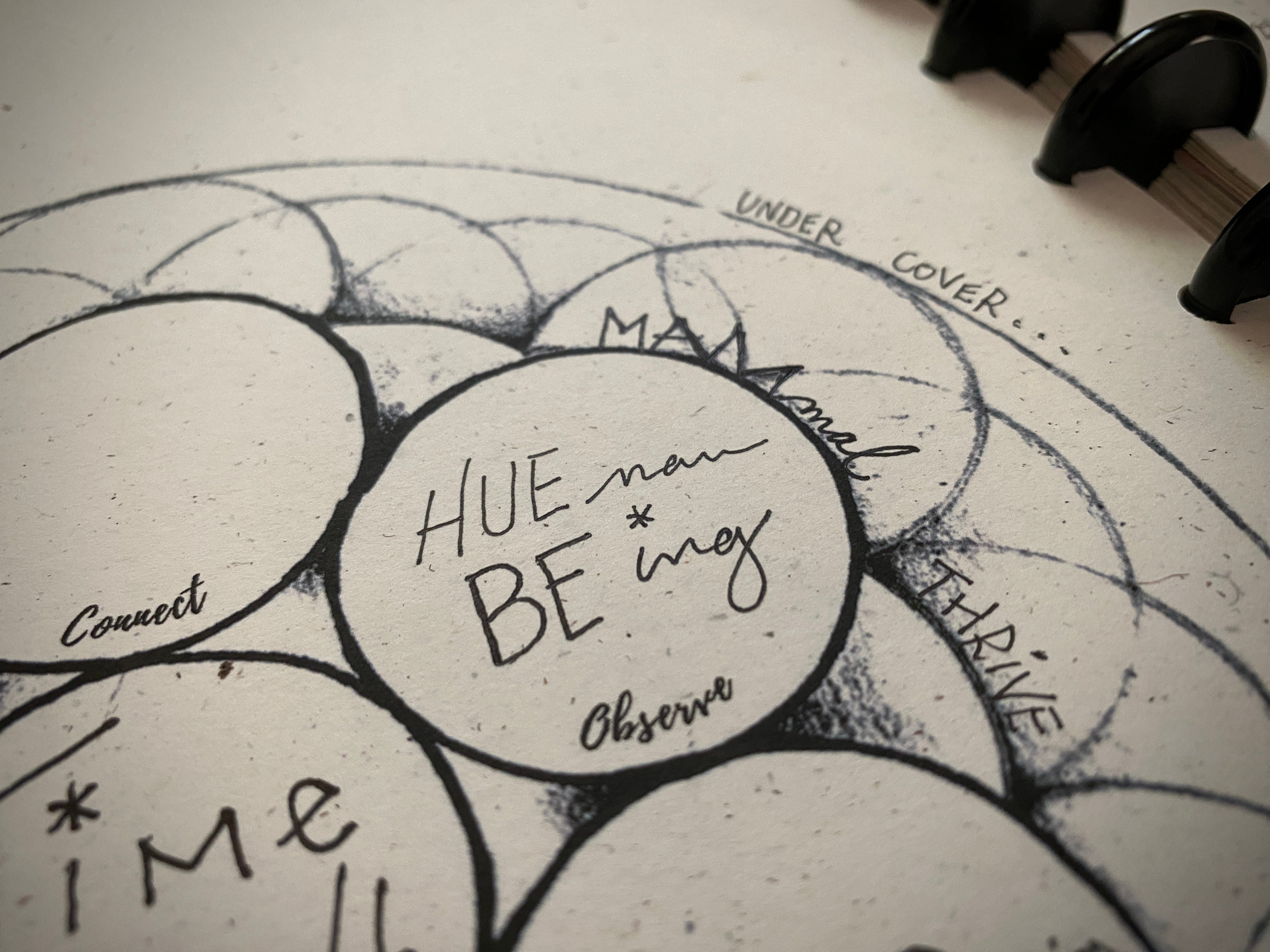
And then there was HUE.
Historically, hue has roots in Old English hiw, with meanings connected not only to color, but also to appearance, form, kind, and species.
Molly knew she wasn’t discovering the actual etymology of human by dividing it into HUE-man.
This was something else.
A symbolic etymology.
A linguistic experiment.
What if a HUE-man is an Earthling understood not as a fixed category, but as an expression?
A particular flavor.
A particular tone.
A particular vibration.
A particular way of being.
Not a hierarchy.
A spectrum of human expression.
The HUE can change.
A person can enter a room carrying one HUE and leave carrying another.
Fear has a HUE.
Confidence has a HUE.
Curiosity has a HUE.
Shame has a HUE.
Generosity has a HUE.
Power has a HUE.
So does exhaustion. So does joy. So does the strange, indefinable feeling of being completely oneself. Perhaps what humans call personality, mood, attitude, presence, energy, or even aura is this changing HUE of being. And perhaps those states influence the experiences we notice, invite, create, tolerate, attract, and repel.
Molly didn’t need to turn that into a mystical law.
She could simply observe it.
When she felt powerful, she moved differently. When she felt valuable, she perceived other people differently. When she felt afraid, the world appeared differently.
The humans hadn’t necessarily changed.
Her HUE had.
That seemed worth exploring...
Because Molly has spent years creating maps about human civilization, conditioning, programming, society, and what sometimes looked like the inevitable downfall of the species.
She has accumulated plenty of evidence for the argument that humans are mammals who have become extraordinarily clever at consuming, reproducing, competing, accumulating, manufacturing, controlling, and separating themselves from the natural world that produced them.
Humans can be animal-istic.
Humans can be cruel.
Humans can destroy.
She doesn’t need to pretend otherwise. But perhaps she has been observing humanity through a particularly narrow HUE.
If the internal message is: HU-MAN is screwed up.
Then perhaps it isn’t surprising that a man crossing the boundary of her body becomes a particularly frightening relevant possibility.
If the species is perceived as fundamentally dangerous, then being a member of that species while inhabiting a vulnerable body becomes its own kind of existential contradiction.
But what if humans are not finished on Earth?
What if the great human experiment is still underway?
A mammal follows the cycles of nature.
It is born.
It grows.
Reproduces.
Adapts.
Ages.
Dies.
But the HUE-man can observe those cycles and ask what they mean. A HUE-man can notice conditioning and question it. A HUE-man can inherit a belief and decide not to pass it forward. A HUE-man can create something that has never existed before. A HUE-man can look at an obsolete object in an antique store and wonder why it matters. A HUE-man can look at an aging body and ask whether age might increase rather than diminish its value.
A HUE-man can recognize a boundary and still choose connection.
I am here.
You are there.
And we can meet.
That is distinction, not division.
Perhaps that is what Molly is learning now. She doesn’t have to escape the mammals reach. She doesn’t have to dissolve the individual self into oneness. She doesn’t have to deny the shadow. She doesn’t have to convince herself humanity is doomed.
She can observe.
She can perceive.
She can gather evidence.
She can let the HUE change.
…And perhaps this is what time on Earth is for.
Not merely to grow older. To become. To accumulate meaning. To discover that development is not deterioration. That age is not the opposite of value. That change does not necessarily mean loss. That an Earthling can become something different without becoming something lesser.
Perhaps Molly is not becoming less safe or valuable with time.
Perhaps she is becoming an antique of her own making.
Not obsolete.
Experienced.
Not less valuable because time has passed.
Valuable because time has passed.
And perhaps the Revolution of Time is not about learning how to stop the clock. It is about learning to recognize what time is actually creating.
An individual expression.
A body with boundaries.
…exploring her Time on Earth.
The Previous Day… Day 3 Intend | Boundaries
👇
The Natural Boundary of Things
Today, Molly is clarifying her desires and it took a conversation with her husband to find out what got crossed…
Want More?
Earth Bound Misfit: A MUSEing on the Art of Being
I could be anywhere—New York City, a small rural town, or deep in the woods—but the truth is, location has never dictated my experience. My reality resides in vision, in reflection, in the way my consciousness interacts with this Earth Spaceship and its assigned Spacesuit—my body, my identity, my coordinates in time and space.


