


The white shirt pattern had taken two weeks to fully form.
The first time the young men appeared on the porch, Molly simply let the knock echo into the quiet house and stayed put. The second time, she opened her kitchen window just enough to explain that she was in the middle of cooking and dismissed them. The third time, she let the knock go unanswered again.
By the fourth visit, Molly decided to make the boundary explicit. She posted a No Soliciting sign on the door, figuring that clear print “Do Not Knock” would save everyone another awkward exchange.
It did not.
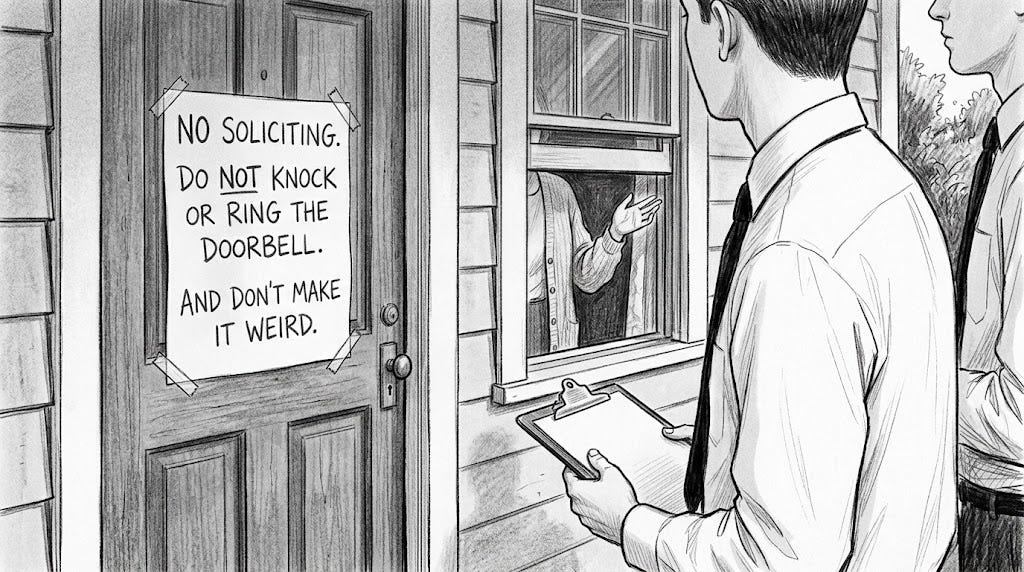
Molly was deep in an afternoon nap, floating under the heavy fog of cold medicine, when a sharp rap on the wood woke her up. She lay there disoriented, processing the sound through a haze of decongestants. She didn’t answer right away, but curiosity eventually dragged her out of bed. Surely, she reasoned, nobody would knock on a door with a fresh sign, unless it was a neighbor in trouble or a delivery driver dropping off a parcel.
“Who is it?” she called out, creeping to the entry and peering through the window pane.
There stood the familiar crisp white shirt.
There was a specific shade of bleached white that seemed unique to young men with clipboards and a mission. It was a white so bright it felt almost aggressive in the mid-afternoon Missouri sun, like a beacon asking to be seen.
They were terribly polite. That was the tricky part. The kingdom of modern manners had trained Molly to treat politeness like an unspoken treaty. If someone approached a doorway with a pleasant expression and a soft cadence, the social code dictated that she was required to stand there, nod along, and absorb whatever script was being delivered.
Except this was visit number four in two weeks.
After he announced where they were from, Molly asked through the window if he was able to read the “No Soliciting” sign on the door. The young man offered a bright, practiced smile and explained that they were not soliciting at all. They were simply inviting her to church.
“Well then you are selling something,” Molly said.
Rather than taking the exit ramp, he immediately launched into a debate, insisting that handing out an invitation was fundamentally different from selling a product.
Standing there in her socks, head heavy with cold medicine, Molly caught herself entering a truly absurd psychological trap. She was actively debating the formal semantics of commerce on her own threshold, waiting for a nineteen-year-old stranger to concede the argument so she could feel justified in ending the conversation.
Human beings have a bizarre habit of treating personal boundaries as if they were bilateral contracts requiring two signatures. We state what we need, and then we stand there holding our breath, waiting for the other person to grant us permission to enforce our own perimeter.
But a front door does not consult a visitor before it locks. A wooden frame does not ask a solicitor for permission to be solid. Molly realized she did not need him to agree with her sign or validate her right to be uninterrupted in her own home.
“You need to leave,” she said.
Instead of stepping off the porch, the young man pivoted without missing a beat, smoothly asking if she had any neighbors nearby that she might recommend.
Molly realized she had wandered into one of those conversations where the other person doesn’t actually have to convince you of anything. They just have to keep talking until you become too socially exhausted to continue.
And Molly was falling into the trap.
She was waiting for him to agree with her.
Why?
Why did she need this young stranger to agree that her own sign meant what it said?
“Do not knock or ring doorbell. Don’t Make it Weird”
Molly cut him off mid-sentence. She didn’t pad her response with polite cushioning or apologize for being sick. She simply repeated herself, flatter and firmer this time.
“You need to leave.”
The debate died instantly in the afternoon air. The young man paused, his practiced momentum finally hitting a proverbial brick wall. Then came the shuffling sound of rubber soles turning on concrete and the light whisperer of voices down the sidewalk toward the neighbors.
Molly stood still as quiet returned to the house, entirely her own. The lesson was almost insultingly simple. A boundary was never an argument she had to win. It was just a piece of solid oak she had to stop opening.