


Molly sat at her desk in the studio of her 1940s bungalow, looking down at her MeMoir. Outside, the rumble of a passing transport truck on Route 66 sent a low, resonant vibration rolling through the floorboards. In the kitchen, the refrigerator motor kicked on with a sudden, shuddering hum.
She noticed her shoulders were sitting somewhere near her earlobes.
Her body had always operated as an extraordinarily high-fidelity receiver. There was no dial to turn down the ambient input of the world. Every pitch, every shift in air pressure, every subtle change in domestic temperature arrived with startling clarity.
For a military kid who had grown up constantly moving and learning to read the emotional weather of familiar and unfamiliar rooms, her nervous system had naturally treated noise as input to her emergency alert system. It was functional hyper-vigilance… an old survival habit designed to intercept the impact of a chaotic environment.
Molly looked back down at her Quantum MeMoir.
She was mapping her Earth Cycle for the week.
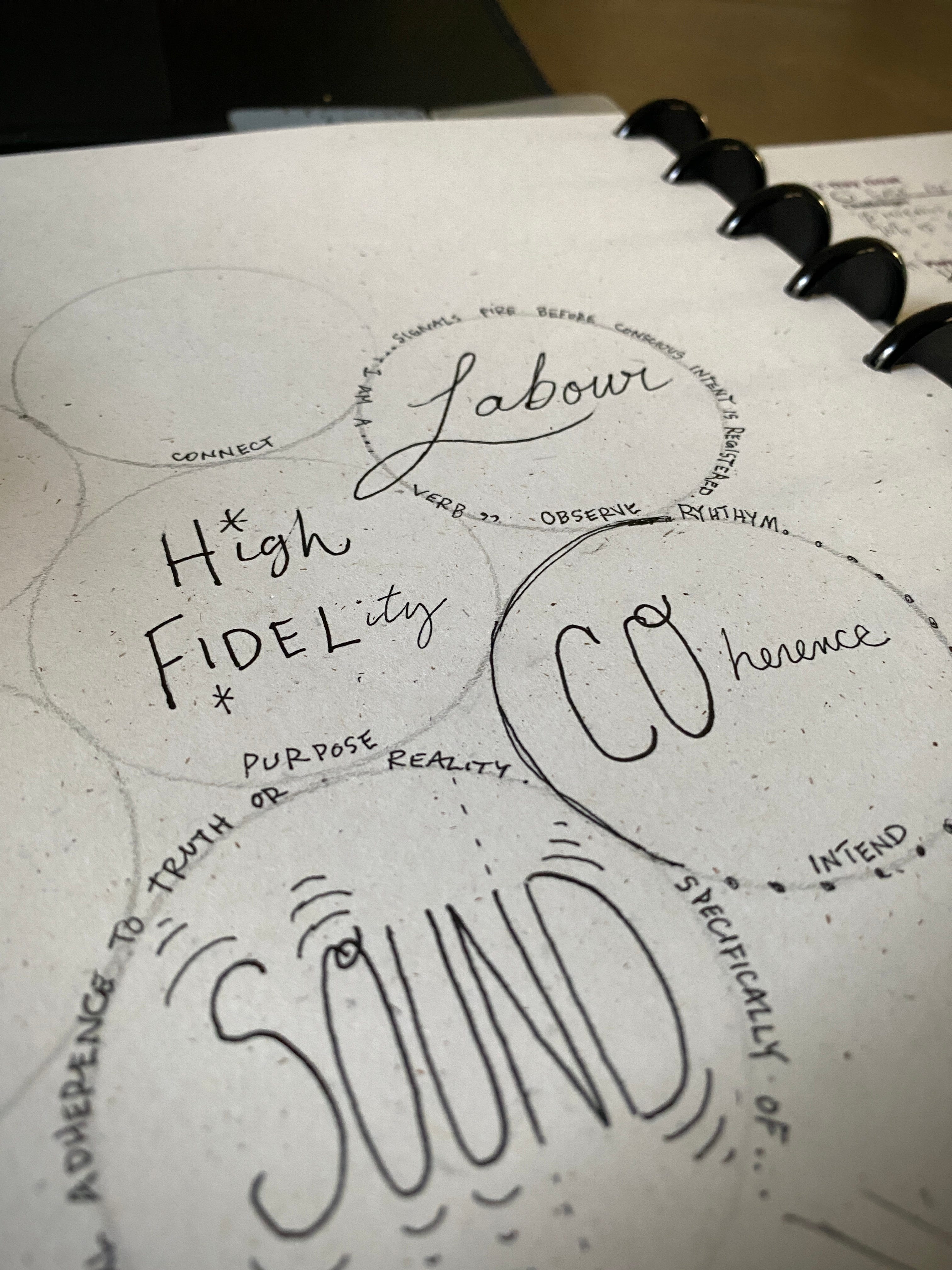
It wasn’t a neat list of rows or lines. It was a geometric mind map. Specifically, she had drawn the sacred geometry pattern… the Base Code of Quantum MeMoir built from seven spheres, where the first day sat perfectly in the center and the remaining six spheres orbited around it.
Day one, holding the center Purpose sphere, was set to High Fidelity.
Orbiting around that center were the coordinates for the rest of the week. Day two had anchored the Ground Sphere in Sound. Day three carried the Intend Sphere toward Coherence. And today, day four, had arrived at the Observe Sphere to examine the Labour.
Staring at the geometry on the heavy paper, Molly realized that the labour had never really been the listening itself. The labor was the exhausting, full-time job of trying to police the broadcast.
Whenever the world got loud, her instinct had been to brace, to decipher, or to scramble for a conductor’s baton to make the room behave. Her radar went to work assuming that if she didn’t monitor every wave, something would crash through the wall of her personal boundaries.
Sitting there in her quiet studio, Molly began to suspect that her understanding of harmony had been far too small. Her life, she saw now, was an ongoing concord of sounds.
Life was never going to be a polite, continuous string quartet.
Sometimes reality arrived like three distorted chords in a basement, sweaty and loud and unapologetically punk rock, full of raw feedback and dropped drumsticks. Other times, the morning arranged itself with the delicate precision of a classical symphony, every rustle of dry leaves and every whistle of the kettle answering each other in exquisite balance.
Neither mode was an error.
The chaos was not a threat, and the symphony was not a reward. They were simply different movements in the same composition.
The revelation landed with a peculiar, physical relief: her only role in this observation was to allow the information to come through in its natural rhythm and sequence. She was not the bouncer at the door checking the credentials of every passing vibration. She was simply the space through which the sound traveled.
Living in a high-fidelity body didn’t mean she was required to brace against the volume. It meant she needed to honor the silence between sound, the rest that makes harmony possible.
The hyper-vigilance had been nothing more than an innocent conditioning, a sensitive instrument believing it was responsible for surviving the sounds instead of merely letting them play.
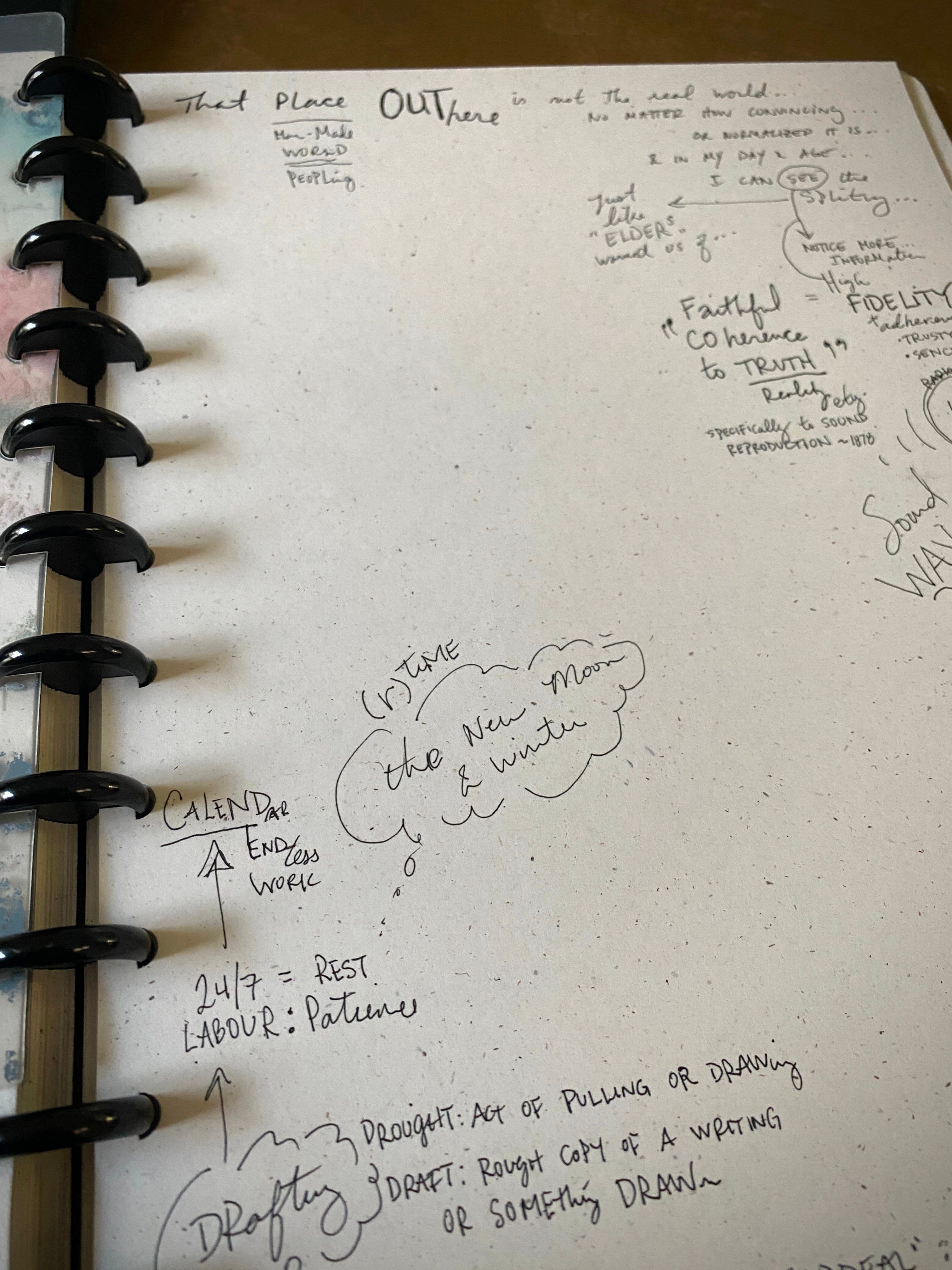
Molly let her shoulders drop. Outside, the broadcast continued, chaotic and beautiful and completely unmanaged, while Molly simply sat in her chair and let the morning pass through intact.
She picked up her pencil and glanced down at the geometric mind map resting on the desk. Day four was quietly settling into place, but three blank spheres were still waiting along the outer ring of the paper. The rest of the week had its own movements yet to unfold. For now, the coordinates were set, and whatever sound came next would have to arrive in its own time.